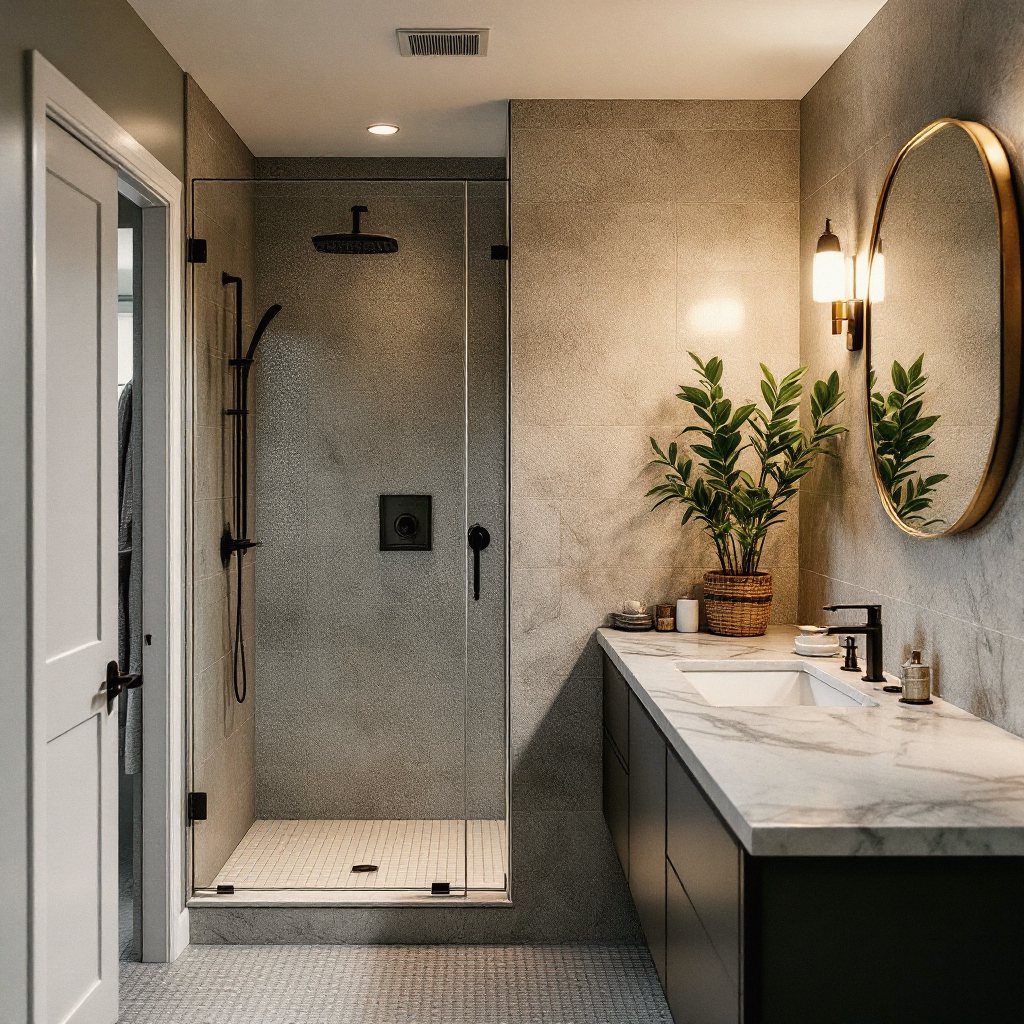
Almost. The question is what your builder left you. Many Fishers-area basements have a rough-in — capped drain stubs in the slab placed for a future bath — and if you have one, you're in the cheap seats: the expensive concrete work is done. No rough-in means either breaking and trenching the slab to reach the main drain by gravity, or an up-flush ejector system that pumps waste up to the existing line. All three paths work; they just carry different numbers, and the design visit tells you which one you're holding.
Full-height tile and glass: basement baths shouldn't look like an afterthought bath.
What does a basement bathroom cost?
With an existing rough-in, a full bath (tiled shower, vanity, toilet, fan, lighting) typically runs $18,000–$30,000 depending on finish level. No rough-in adds $5,000–$12,000 for trenching or ejector work. Half baths run proportionally less. These numbers fold into a full-finish contract or stand alone if your basement is already finished but bathless.
Wet bars: from beverage station to second kitchen
The dry bar — cabinetry, counter, shelving, fridge. No plumbing, big effect. From ~$6,000.
The wet bar — add a sink and you add real function: $10,000–$20,000 with stone, tile and lighting.
The full second kitchen — dishwasher, full fridge, sometimes a range (code and venting decisions apply). The in-law-suite and sports-season favorite: $25,000+.
Bar placement rides the same plumbing logic as bathrooms — putting bath and bar on one wet wall saves real money, which is why they get designed together, not bolted on separately.
Look for capped PVC stubs in the slab, usually in a corner or near the mechanicals, sometimes under carpet in a 'future bath' bump-out. We confirm at the design visit — including whether the builder placed them somewhere useful.
Are ejector systems reliable?
Modern sealed ejector systems are quiet, code-approved and standard practice. They add a maintenance item but remove tens of feet of slab trenching. We spec them where the math favors them and say so plainly.
Can I get a steam shower or heated floor down there?
Both are excellent basement moves — electric heated tile in a basement bath is the best comfort-per-dollar upgrade we install.
Does a basement bathroom need a window or just a fan?
A properly sized exhaust fan meets code; windows are optional. Ventilation done right matters more below grade than anywhere else in the house.
Will my water heater and softener handle another bath?
Usually — but we check capacity at design rather than discover it at first shower. If the mechanicals need upsizing, that's a line item you see up front.