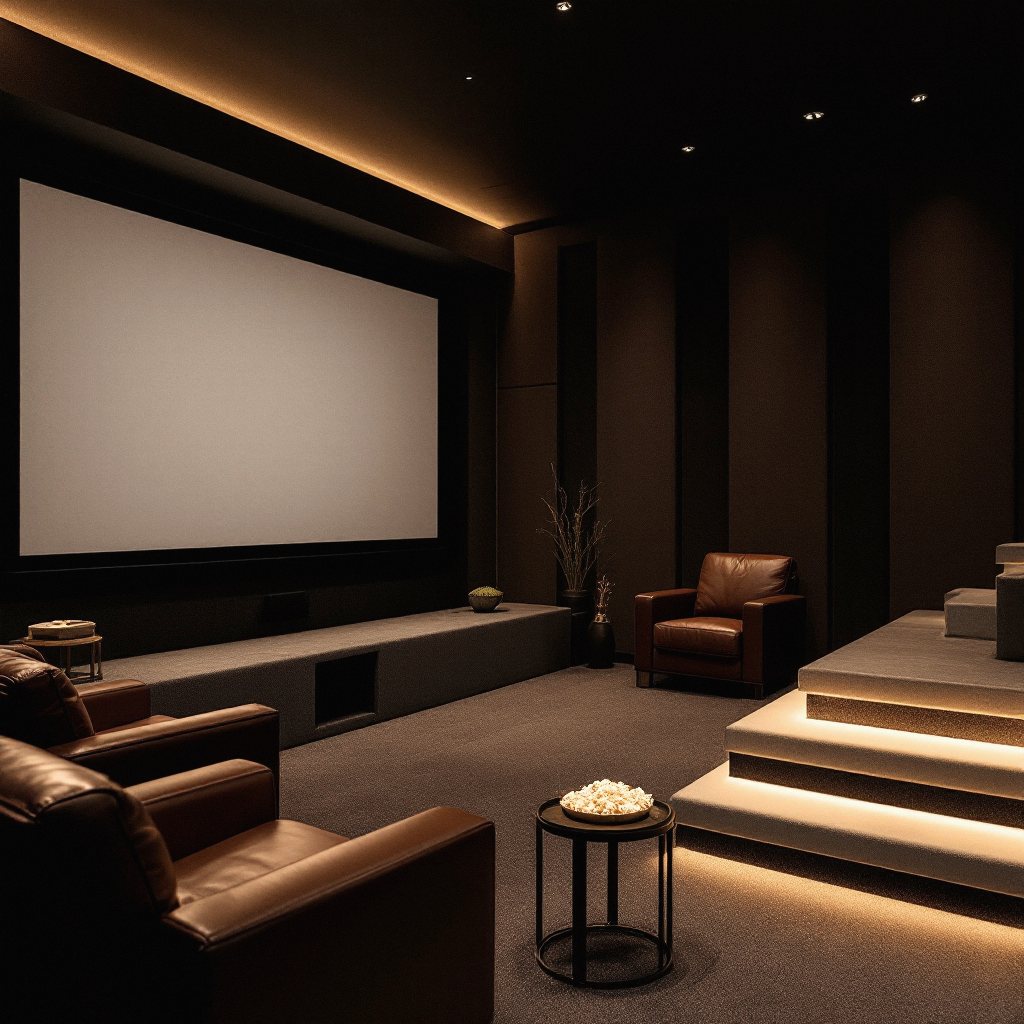
Every other room fights the basement's nature. A theater is the one room that wants exactly what a basement is: dark, quiet, and separate from the household above.
Dedicated theater or media room — which should I build?
A dedicated theater is a single-purpose instrument: controlled light, fixed screen, tiered seating, acoustic treatment, and a door that closes. A media room is a great room that happens to have a serious screen — couch depth, a bar within reach, lights that come up for the game. The honest sorting question: will you watch two-hour films with focus, or host twenty people for playoffs? Fishers builds split about 30/70 toward media rooms, and we design both — often a media room with theater-grade bones (wiring, acoustics) that can be committed later.
Tiered platforms are framing, wiring and carpet — modest cost, permanent sightlines.
What separates a real theater build from a TV in a basement?
Sound isolation — insulation, channel-mounted drywall and solid doors keep explosions downstairs and bedtimes upstairs intact.
In-room acoustics — first-reflection treatment and bass management, planned at framing, not glued on after.
Screen math — viewing distance decides screen size and projector vs. large-format TV; we run the numbers instead of guessing.
Lighting control — layered, dimmable, zoned; step lights for tiers; nothing reflecting off the screen.
Equipment ventilation — racks and projectors make heat; closets that cook electronics are a classic DIY casualty.
What do theaters cost?
As part of a full finish: a media-room build with proper wiring, acoustic insulation and lighting adds $8,000–$20,000 over standard living space. Dedicated theaters — tiers, treatment, isolation, equipment — typically run $25,000–$60,000+ all-in depending on gear tier. Equipment can be yours, ours to spec, or a hybrid; the build is wired for the upgrade path either way.
Under ~100 inches of screen at typical distances, modern large-format TVs win on brightness and simplicity. Beyond that, projection wins on immersion and cost-per-inch. Your row distance decides — it's arithmetic, not preference.
Can you soundproof so kids sleep upstairs during movies?
Meaningful isolation, yes — insulation, resilient channel, solid-core doors and sealed penetrations knock the transfer down dramatically. 'Recording-studio silence' claims are sales talk; big honest reduction is buildable.
Do I need a riser for a second row?
At two rows, yes — a 10–14 inch platform keeps row two's sightline clean. It's framing and carpet, not exotic construction, and it hides subwoofers beautifully.
What about snacks — bar in the theater?
The classic combo is bar at the back or just outside the door. Same wet-wall logic as everything else; see the bathrooms and wet bars page.
Can you wire for Atmos / future formats?
We rough-in for more channels than you'll install today — ceiling speakers, conduit runs to the rack, spare pulls. Wire is cheap during framing and miserable after drywall.